

When people talk about electrification, the spotlight usually goes to the supply side: more renewables, stronger grids, better batteries, more chargers.
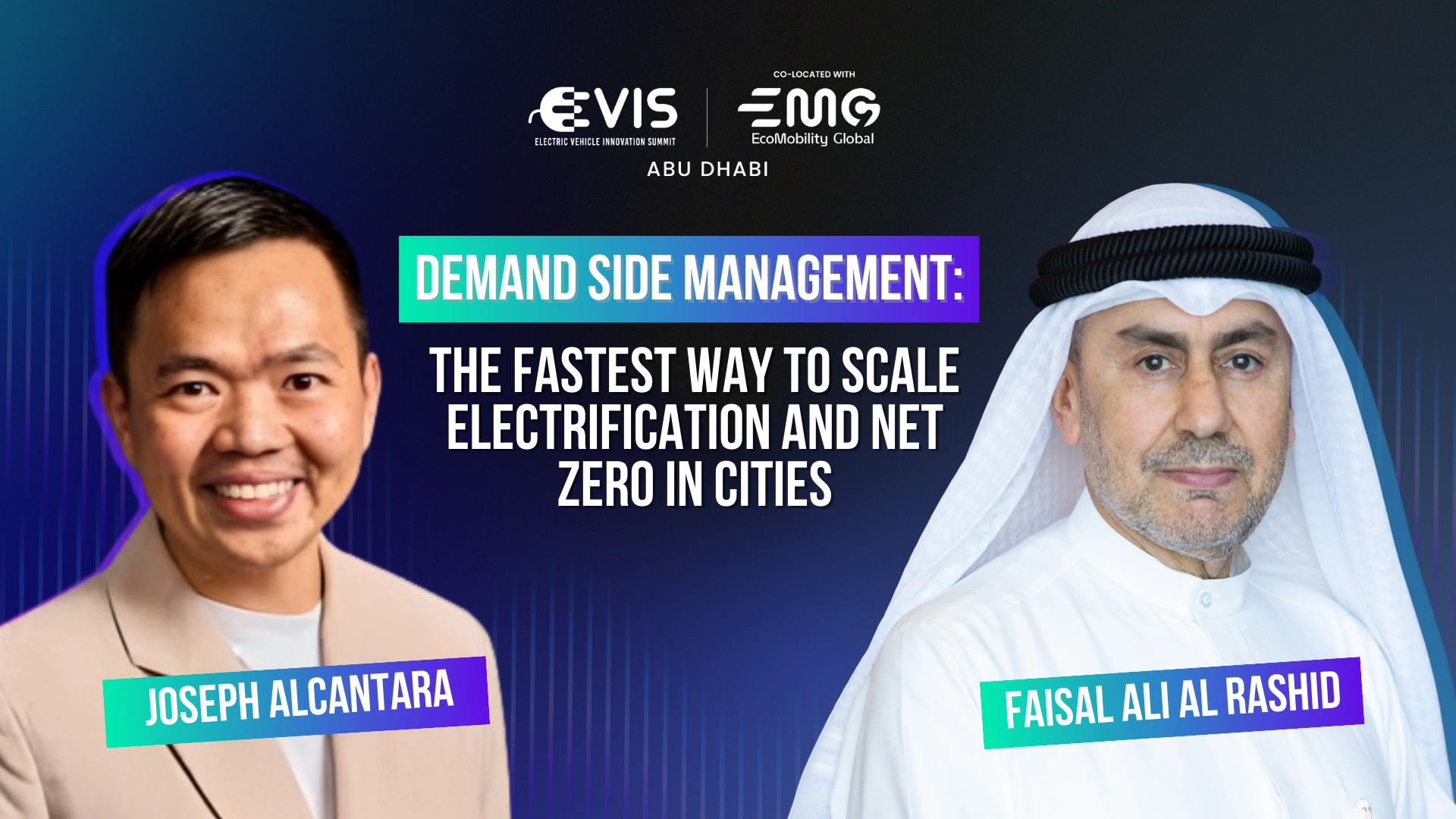
But in this EVIS-EMG podcast episode, we focused on what often delivers the fastest wins at city scale: demand side management (DSM).
DSM is the “how” behind real-world progress. It is how cities reduce consumption while still growing, how electrification scales without compromising reliability, and how policies turn ambitious net zero goals into outcomes that can be measured, funded, and repeated.
To unpack that, I sat down with Eng. Faisal Ali Rashid, a government leader translating strategy into delivery as Senior Director of DSM at Dubai’s Supreme Council of Energy, and an EVIS-EMG Advisory Board Member helping steer the conversations that matter across the region.
Key takeaways from the episode
1) Electrification does not scale on supply-side progress alone
A central theme throughout the discussion: DSM turns ambition into adoption.
At city scale, electrification creates new patterns of demand. Without planning for those patterns, the transition becomes harder, slower, and more expensive. DSM helps cities manage peak loads, improve efficiency, and design systems so electrification is reliable and economically viable.
Bottom line: energy transition is not only about producing cleaner energy. It is also about using energy smarter.
2) Dubai’s DSM Strategy is built for measurable outcomes
Faisal shared how Dubai approaches DSM through a portfolio of programs and enabling mechanisms that support long-term targets.
Rather than treating DSM as a single initiative, the strategy is framed as an integrated operating model that includes:
- Policy, standards, and regulation
- Incentives and market mechanisms
- Governance and cross-entity coordination
- Data and measurement to track progress and refine execution
The episode also explored how DSM connects across sectors like buildings, cooling, water, and transport, reinforcing a key point: efficiency is not a constraint. It is an accelerator for growth.
3) Efficient mobility and smart charging belong inside DSM
EV adoption is often framed as a transport story. In this conversation, we explored why that framing is incomplete.
From a city execution lens, EV growth is also:
- A grid planning issue
- A peak demand issue
- A resiliency issue
- A system design issue
That is why Faisal emphasized the importance of treating efficient mobility and smart charging as part of DSM, not as standalone projects. Smart charging in particular was discussed as something that must be designed for real city conditions, not only for ideal scenarios.
A useful reframe from the episode: smart charging is a system design problem, not a charger problem.
4) Partnerships scale when they align with policy, measurement, and real adoption
A recurring message for private sector stakeholders was clarity on what makes partnerships “bankable” and scalable.
The episode highlighted that successful collaboration requires alignment on:
- Policy direction and standards
- Measurable outcomes and performance indicators
- Deployment realities, not just pilots
- The enabling mechanisms that turn solutions into programs
For OEMs, charging providers, and energy solutions companies, this is a reminder that winning markets is not just about innovation. It is about integration with how governments execute.
Why this conversation matters for EVIS-EMG
EVIS-EMG exists to do more than spotlight innovation. It is a platform built to align stakeholders around execution, connecting government leadership, OEMs, suppliers, solution providers, investors, and infrastructure partners around the decisions that accelerate adoption.
This episode reinforces the EVIS-EMG focus on real-world delivery, and why advisory voices like
Faisal’s help keep the ecosystem pointed toward outcomes. If you are working on:
- Energy efficiency and demand reduction
- EV readiness and smart charging
- Fleet transition
- Policy-aligned infrastructure deployment
- Scalable partnerships in the UAE and broader region
Then this is the kind of conversation that sets the foundation for the right partnerships and the right action.
Join the conversation
Faisal Ali Rashid will be part of EVIS & EcoMobility Global 2026, where leaders across government, industry, and innovation will shape the next chapter of mobility.
Learn more about the platform and how to participate at: https://abudhabi.evinnovationsummit.com/
https://ecomobilityglobal.com/