

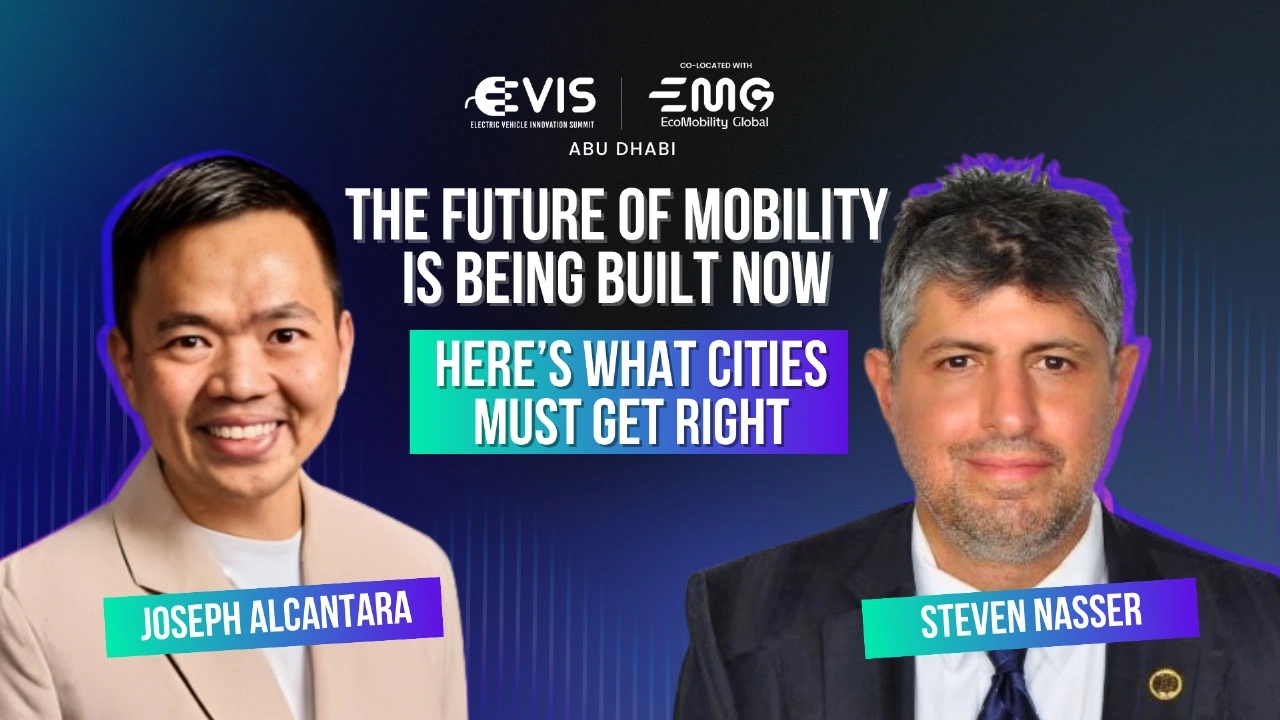
In a recent Electric Vehicle Innovation Summit & EcoMobility Global podcast conversation, Steven “Shafik” Nasser, CEO of Altair Advisory and Chairman of the ITS Committee at the International Road Federation (IRF), shared a grounded, systems-level view of what it will truly take to make electric, autonomous, and intelligent mobility work at scale.
This wasn’t a conversation about hype. It was about readiness.
Key insight #1: AI is only powerful if cities know what to do with data
According to Nasser, intelligent transport systems have been collecting data for years. What’s changed is our ability to process it meaningfully.
True intelligence, he explains, isn’t about installing more sensors. It’s about using AI to predict traffic behavior, reduce congestion, prevent accidents, and inform urban planning decisions before problems occur.
Cities that master this transition will move faster, safer, and smarter than those still treating AI as a buzzword.
Key insight #2: Autonomous mobility demands a mindset shift, not just technology
Autonomous vehicles are advancing faster than many realize. But infrastructure readiness means more than road markings or connectivity.
It requires:
- Clear testing and certification frameworks
- Alignment between regulators, operators, and technology providers
- Solutions designed specifically for local conditions, not copied from other markets
As Nasser puts it, the difference between success and delay often comes down to coordination, not capability.
Key insight #3: Mobility is no longer just on land
As EVTOLs and aerial mobility gain momentum, cities face a new layer of complexity.
These are not “flying cars.” They are aircraft, governed by aviation-grade safety, compliance, and monitoring standards. Preparing for this future means rethinking traffic management, airspace control, and public safety from the ground up.
Why platforms like EVIS & EcoMobility Global matter
What makes EVIS Abu Dhabi and EcoMobility Global essential is not scale alone, but convergence.
They bring together energy, transport, policy, infrastructure, AI, and investment into one integrated conversation. Because no single stakeholder can deliver the future of mobility alone.
As Nasser reminds us, collaboration is not optional if this transition is to succeed.
Join the conversation
Steven Nasser will be part of EVIS & EMG 2026, where leaders across government, industry, and innovation will shape the next chapter of mobility.
Learn more about the platform and how to participate at: https://abudhabi.evinnovationsummit.com/ ecomobilityglobal.com