


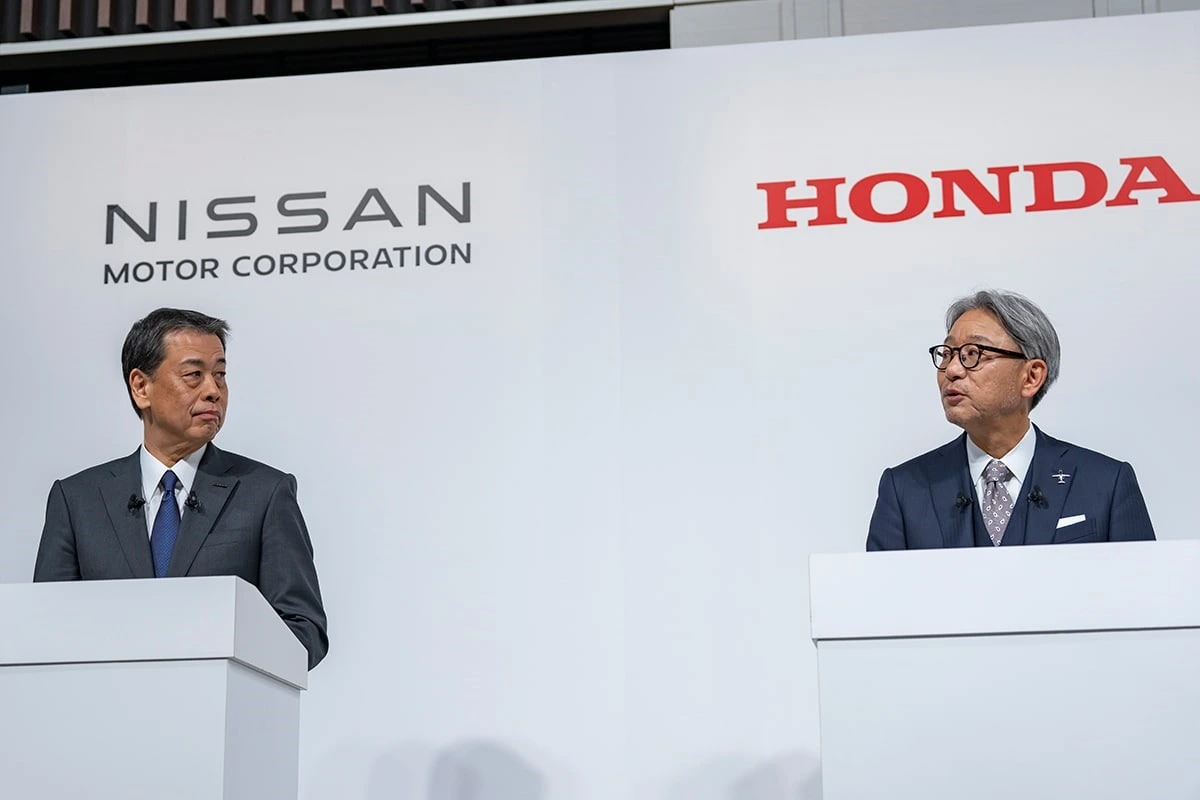
According to Arabian Business, the automotive world has been rocked by the announcement that Honda and Nissan, two iconic Japanese car manufacturers, will join forces to redefine the global automotive industry. They have confirmed they are in talks to merge and list the holding company on the Tokyo Stock Exchange by August 2026.
On Monday, the two companies revealed they had signed a memorandum of understanding (MoU) and will be joined by Mitsubishi Motors, the smaller alliance member of Nissan. This merger will create a powerhouse capable of competing with industry giants like Toyota and Volkswagen.
This strategic alliance will bring their combined annual sales to approximately 8.5 million units. Honda, producing 4 million units each year, and Nissan, with 3.4 million cars sold annually, will be bolstered by Mitsubishi’s contribution of over 1 million vehicles. While the combined figure is impressive, it still falls short of Toyota’s 11.5 million cars produced in 2023 and Volkswagen’s 9 million.
In a groundbreaking move, Honda and Nissan have announced their merger, joined by Mitsubishi Motors. This strategic alliance will bring their combined annual sales to approximately 8.5 million units. Honda, producing 4 million units each year, and Nissan, with 3.4 million cars sold annually, will be bolstered by Mitsubishi’s contribution of over 1 million vehicles. While the combined figure is impressive, it still falls short of Toyota’s 11.5 million cars produced in 2023 and Volkswagen’s 9 million.
The merger is driven by the need to regain a foothold in the competitive electric vehicle market. Both Japanese firms have struggled to match the advancements of Tesla and emerging Chinese EV manufacturers. Honda will initially lead the new management, ensuring that the unique principles and brands of each company are preserved while creating a unified front to tackle future challenges. At a joint press meeting on Monday, Honda CEO Toshihiro Mibe stressed the urgency of the move, citing the rapid changes in the industry brought on by new players. “The rise of Chinese automakers and new players has changed the car industry quite a lot. We have to build up capabilities to fight with them by 2030, otherwise we will be beaten. Current business models are being upended. It is not going to take 10 to 20 years for that to happen, it will come much faster. We need to have the right artillery in order to be competitive on that battlefield, so we’re starting today,” he stated.
The alliance also highlights contrasting financial situations among its partners. Nissan has faced significant struggles, reporting a 94 percent drop in profits for the six months ending September 2024 compared to the same period in 2023. The company has responded by reducing its manufacturing output by 20 percent and laying off 9,000 workers. Despite these challenges, Nissan’s CEO Makoto Uchida remained optimistic, calling the merger “a pivotal moment.” He emphasized the opportunities for collaboration to create unique innovations that neither company could achieve alone.
The announcement has been positively received in the market. Shares of Honda Motors rose by 3.82 percent, reaching JPY1,276.5, while Nissan saw a smaller but notable increase of 1.58 percent, with shares trading at JPY450. This investor confidence underscores the belief in the potential of the new alliance to reshape the automotive landscape.
By merging their strengths and addressing their weaknesses, Honda, Nissan, and Mitsubishi are setting a new course toward a more sustainable and competitive future in the automotive industry. The global market will undoubtedly watch closely as this newly formed powerhouse takes its first steps toward redefining success in an ever-evolving field.
Source: Arabian Business